
Marshall County Owner Record Card
The Assessor's owner clue lives in the county's DataPitstop tax detail. Read it as a dated record card. The card is no title certificate, and mistaking one label for another is easy when the fields sit side by side.
| Deeded Owner | The named owner line and its displayed date |
|---|---|
| Mailing Address | Where tax or official mail is directed when public |
| Property Address | The situs-like location of the parcel |
| Parcel / PIN / Tax ID | Separate identifiers that bridge county systems |
| Legal Description | The land-description text used to match the deed |
| Payable Year | The year snapshot governing the tax display |
The current owner is not always the occupant. A mailing address can sit off-site, while Property Address marks the subject location. Neither proves where a person actually lives. A trust, estate, or company can hold title as owner of record, and its complete name must carry into the Recorder search.
See Marshall's Dated Owner Line
The Marshall County tax detail displays the exact Deeded Owner label beside the other parcel and tax fields.
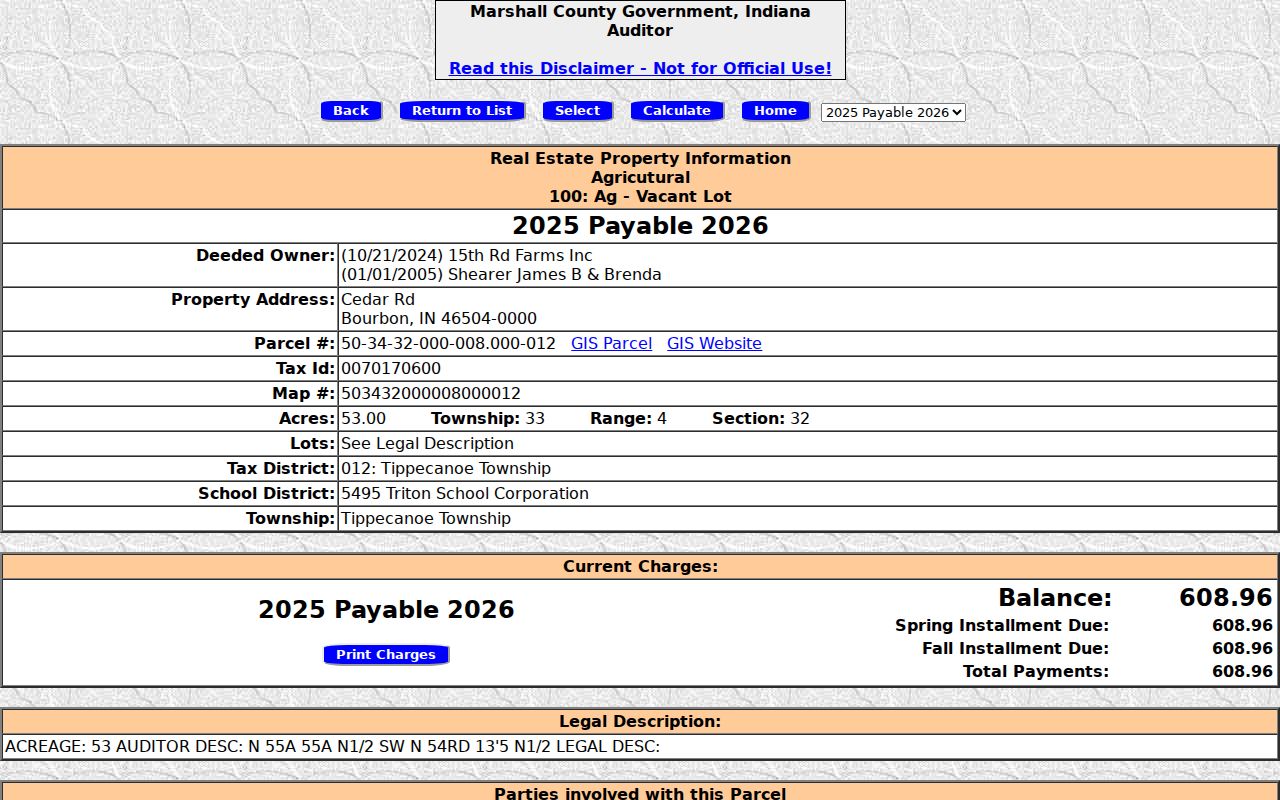
The page makes the dating explicit. A Deeded Owner line only means what its payable year, APN, property address, legal description, and transfer information say it means.
How Current Is Marshall's Owner
Marshall County posts no fixed closing-to-roll lag. Do not assume thirty days or a quarter. The assessment date and payable-year selector can make a valid tax snapshot look stale next to a deed recorded later. So build a date bridge. Line up the access date, the selected payable year, the Deeded Owner date, the deed execution date, and the recording date. Probate or foreclosure adds court dates. The court event and final transfer date slot into the same bridge, which exposes any apparent conflict without guessing.
Recent sale check. The newest valid recorded deed is the stronger current-owner lead when its legal description matches and the tax card still shows an older dated owner.
Parcel Changes Hide Current Owners
DataPitstop itself recommends owner-name searching after a parcel split or combination. An old APN can stop returning the expected bill. A surname or entity name will surface the new parcel rows instead. Keep both identifiers and compare their legal descriptions.
The Marshall record shows both formats. The APN appears dashed, and the PIN appears undashed. A portal or export may accept one format but not the other. No official source documents every reassignment rule.
Note: A missing old parcel result can mean a split or combination, not the absence of a current owner record.
Confirm Marshall County's Current Owner
Start with the DataPitstop tax list. Then move to the Recorder's Tapestry/EON index. For a current-owner check, the goal is the latest matching deed rather than a full historic chain.
- Search by address or APN, select the payable year, and save the newest Deeded Owner line.
- Copy the legal description and every parcel identifier from the detail.
- Search Tapestry/EON by grantee name, recording date, document type, and legal-description clues.
- Read the newest deed image or request the instrument from the Recorder, then compare its land description.
- Owner of record
- The party named by the relevant official ownership record.
- Assessment roll
- The Assessor's year-based record used for value and tax administration.
- Recording lag
- The gap between a deed's recording and its appearance in another county system.
- Situs
- The subject property's physical address, distinct from owner mail.
Verify Marshall Entity Ownership
An LLC or corporation needs its exact entity name. Carry that name straight from the tax card into the deed index. The Indiana INBiz search can clarify the entity's public filing record. But an agent who receives notices is not necessarily the owner. Trusts and estates deserve the same care. The deed may name a trustee or personal representative in a stated capacity. Match the grantee against the legal description. When probate authority affects a recent transfer, MyCase and the Clerk offer the public court lead. The recorded deed remains the land-transfer record.
Ask Marshall's Records Offices
Start with a call to the Assessor. Dial (574) 935-8525 about the roll and the payable-year display. Do this whenever the card and the deed fail to line up. Request the property card, assessment record, owner display, and mailing address if public. The land and improvement values belong in the same request. Deductions, sales-disclosure reference, and appeal notices for the relevant years go in it too.
The Recorder sits in Room 201 at 112 W Jefferson Street in Plymouth. The office takes calls at (574) 935-8515. Weekday hours run 8 a.m. to 4 p.m. Provide the grantee, grantor, approximate date, APN, and legal description. Ask whether the year is indexed, imaged, or office-only. Request a copy fee estimate.
Date Every Marshall Owner Answer
Time stamps make or break a current owner answer. Save the portal access date and the payable year. Also save the dated Deeded Owner line, the deed execution date, the recording date, and any parcel-layer date. Conflicts happen. When they do, report the conflict instead of trusting whichever screen looks newest. The latest matching recorded instrument remains the lead for confirming title. The Assessor explains its own assessment roll.
Assemble a compact packet for each parcel. It should carry the full APN and PIN and the property address. Add any separate mailing address and the exact legal description. Include the displayed owner, the instrument number, grantor, grantee, recording date, and an image reference. This habit prevents two common errors. One is carrying the right name from the wrong year. The other is attaching a correct deed to a neighboring parcel.
No online deed image? Request the instrument from the Recorder by party, approximate date, APN, and legal description. For older material, ask whether the record sits in a deed book. It may instead sit in a microfilm run or an office-only index. A failed web search proves nothing. It does not establish that no current owner record exists.
Name variants matter when a person or business fails to match across systems. Test the exact legal name, a surname plus initial, and an entity name stripped of punctuation or suffix. Tapestry guidance permits `%` in place of an apostrophe. Platted land responds to the county's indexed subdivision spelling with lot and block. Rural land responds to section, acreage, and other legal-description fragments.
The GIS map cannot substitute for this confirmation. Beacon supplies parcel shape, roads, municipality, zoning, flood, PLSS, and school context. But its label is not the deed. A sales disclosure is similar. It links to a conveyance without being the deed itself. Both sources help you identify the right land and the right event; the recorded instrument shows the transfer.
Recent court events can complicate the answer. Foreclosure, quiet title, partition, or probate may generate a complaint, judgment, or sale order. That can happen before any new deed is recorded. Treat MyCase as a lead only. Ask the Clerk for the official public file when it matters. Then return to the Recorder to confirm whether a land-transfer instrument followed.
Use Marshall Owner Records Lawfully
A public mailing address can open a route for property-related correspondence. Keep it separate from the property's situs and from any claim about occupancy. Indiana's Address Confidentiality Program and protected voter rules can limit disclosure for qualifying people. Those protections are not a general deed-deletion process.
Make every current-owner answer reproducible. Record the access date. Record the payable year, owner-line date, APN, instrument number, recording date, and legal description. Indiana's Access to Public Records Act, IC 5-14-3, supports focused requests for public records during business hours. Those requests are subject to exceptions and fees.
Lawful use. Use Marshall County owner information for legitimate property questions. Never use public details to stalk, harass, intimidate, or harm anyone.