
Compare the Marshall County Property Value Numbers
Marshall County assessment records operate inside Indiana's market value-in-use framework. The Department of Local Government Finance sets a 100 percent assessment ratio. It layers on annual adjustment plus ratio-study methods. Still, the numbers on a parcel card serve different masters. Every value carries its own date, purpose, and source.
| Value | What It Is | Where |
|---|---|---|
| Assessed value | The tax-system measure under Indiana's market value-in-use framework | Assessor, Beacon, or tax detail |
| Market value-in-use | The DLGF concept behind assessment, based on the property's current use | Assessment framework and local record |
| Taxable value | The assessment after applicable deductions, distinct from tax credits | Tax calculation and deduction fields |
| Last sale or consideration | A past transfer amount, where disclosed; not a current appraisal | Sales disclosure or recorded deed index |
| Land and improvements | Separate components that may explain a total assessment | Property card or assessment file |
A recorded consideration can hide transaction terms, exemptions, or bundled property the summary never shows. A deduction alters the taxable math without touching the underlying sale. Match like years and like property classes before reading any trend.
Indiana.s Ratio Shapes Marshall Property Assessments
The DLGF assessment overview states that Indiana assesses property at 100 percent of market value-in-use. The "in-use" part is doing real work here. This is a mass-assessment system built around a property's current use. It is not a custom appraisal written for one buyer's pending deal. Ratio studies and annual trending keep assessed levels aligned with the state standard. They do so across property classes and areas.
- Assessed value
- The local value carried for assessment under state rules.
- Market value-in-use
- Indiana's value concept for property in its current use.
- Assessment ratio
- The relationship between assessment and the market value-in-use standard; Indiana states a 100 percent level.
- Sale consideration
- The amount or value reported with a transfer where the record supplies it.
- Reassessment
- A review that updates property data and valuation within the state cycle.
These definitions clear up a common puzzle. A Marshall County property value can be exactly right for assessment and still miss an offer, an appraisal, or a prior sale. The sources are simply answering different questions.
Look Up a Marshall County Assessed Value
The Marshall County Assessor links Beacon, and DataPitstop offers a field-rich tax and assessment search. Begin with the address, but save the parcel number before comparing figures. A split, combination, or address variant can quietly point you to the wrong tract.
- Search the full address or parcel number in the Marshall County Beacon or DataPitstop route.
- Confirm the APN, legal-description text, property class, tax district, acreage, and payable year.
- Record the land, improvement, total assessment, deductions, and calculation fields actually shown.
- For a sale reference, check the public sales disclosure and the Recorder's deed consideration field where available.
- Label every number with its source and date, then compare the same value type across the same year.
DataPitstop covers payable years from 2005 Payable 2006 through 2025 Payable 2026, and the selected year controls the snapshot you see. When the online record runs thin, ask for the property card or assessment file from Assessor Peter Paul, Room 307, 112 W Jefferson Street, Plymouth, at (574) 935-8525. Note: The county tax-list page carries a "Not for Official Use" label, so confirm any decision-critical value with the Assessor.
Read Marshall County Value Fields in Context
A DataPitstop parcel detail offers more than a single total. It places assessment and tax calculations beside the parcel number, tax ID, dated Deeded Owner entries, legal-description text, tax district, classification, acreage, school corporation, and deductions. Those surrounding fields decide whether two records compare at all. The Marshall County parcel card shows that full context.
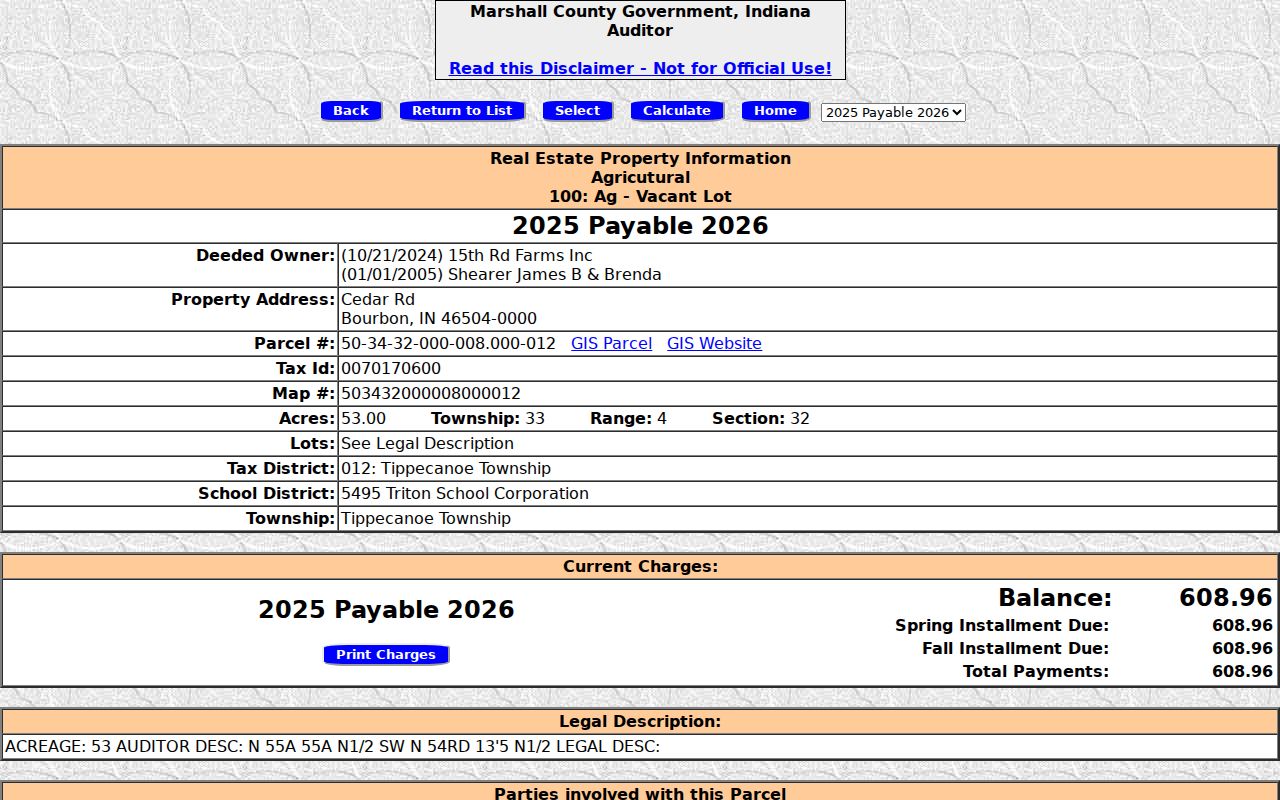
That sample is agricultural, carrying a 53-acre description and Cap 2 agricultural classification. Treat it as a warning against comparing rural acreage with an improved town lot. A shift may trace to class, deductions, improvement data, or reassessment rather than any sale.
Where Marshall County Sale Price Evidence Lives
DLGF makes sales disclosures filed after July 1, 2008 publicly searchable, though phone numbers on those forms stay restricted under IC 6-1.1-5.5-3(d). A disclosure attaches to a conveyance but is not the deed itself. The Recorder's Tapestry search fields may also display consideration. When a prior sale matters, pair both sources with the recorded legal description.
| Record | Value clue | What to verify |
|---|---|---|
| Sales disclosure | Reported transfer details | Parcel, conveyance, form date, exclusions or filing context |
| Recorded deed index | Consideration field where supplied | Instrument, parties, date and legal description |
| Assessment card | Assessed and component values | Assessment or payable year, class and deductions |
| Private appraisal | Opinion for its stated date and purpose | Scope, effective date and property inspected |
A sale number works as a benchmark, nothing more. Time, property condition, odd transaction terms, and parcel changes can make it a weak present-day estimate. It belongs beside the assessed value, never in the same column.
Deductions Change Marshall County Taxable Value
Indiana separates deductions from credits. A deduction shrinks the assessed amount feeding the calculation. A credit cuts liability under its own rules. Neither one moves a property's market sale price, so describing them that way misleads. Read the tax-card calculation and the named deduction fields. Don't subtract a guess from the assessment. The bill, exemptions, payment status, and appeal steps live on the Marshall County property tax records page. That split keeps the assessed-value question from turning into a second tax-bill guide.
Marshall County Property Value Timing Changes
Values can move with no deed recorded at all. Annual adjustment and cyclical reassessment both change the assessor's numbers on their own schedule. DLGF's next four-year cyclical reassessment begins July 1, 2026 for the 2026 Pay 2027 cycle. It reviews 25 percent of parcels each year. Compare the same assessment or payable year. Note whether a property enters a new review period.
| Date or cycle | Value event | Research effect |
|---|---|---|
| January 1 assessment date | Assessment snapshot | Anchor the property data to its assessment year |
| Annual adjustment | Trending within state framework | A value can change without a parcel sale |
| July 1, 2026 cycle start | New four-year reassessment begins | One quarter of parcels reviewed per year |
| Deed recording date | Transfer enters Recorder chain | May not align with the payable-year display |
Source-date discipline keeps two accurate records from looking contradictory when they simply describe different points in time.
Compare Like Marshall County Properties and Years
Start any comparison with use and class. Those two traits matter more than geography. The sample parcel here sits in Tippecanoe Township. It carries an agricultural class and spans 53 acres, with a Triton school corporation field and a Bourbon mailing address. A downtown Plymouth parcel, a lake lot near Culver, and a rural agricultural tract share a county but little else. So they make a poor comparison set.
Line up land area, improvement type, class, jurisdiction, assessment year, sale date, and legal description beside each value. Beacon can supply spatial context, though its polygon and overlays do not appraise anything. A sharp change may stay unexplained. Ask the Assessor for the property card and the supporting assessment file instead of guessing at a market event.
Verify a Marshall County Property Value Offline
Online access is not the only route. At the County Building, the Assessor can hand over the public property card and the payable-year assessment record. Forms and notices are available there too. Put the full APN, property address, and years wanted in any written request. Include land and improvement values, class, deductions, the sales-disclosure reference, and appeal notices. Ask for a fee estimate if copies are needed.
For material no portal supplies, Indiana's Access to Public Records Act, IC 5-14-3, sets the general inspection and copying framework. Exceptions, retention rules, and fees still apply. Direct the request to the actual custodian. Name the record, the date range, the desired format, and your contact information. For a deed image or its consideration field, the Recorder is the proper source. The Assessor is not.
Note: A "no result" can mean an old identifier, split parcel, different custodian, unindexed year, or address variant rather than no record.
Limits of Marshall County Property Values
An assessment is a tax-system figure, built under Indiana's market value-in-use framework. It is public and official. It is not, however, a promise of future sale price, a title opinion, a boundary survey, or a private appraisal pinned to an effective date. A deed's consideration records a transfer clue, not current worth. Beacon's polygon adds location context but no valuation opinion.
Value is not price. A Marshall County assessed value supports taxation and is not what a property is certain to sell for. A licensed appraisal answers a separate market question.
Let each document do its own job. The assessment, sale disclosure, deed, parcel card, and a current professional opinion serve different purposes, and clear labels beat forcing them into one estimate.