
Marshall County Tax Record Fields
Marshall County property tax records change with the year. So treat every figure as a snapshot rather than a fixed fact. The public DataPitstop detail for a parcel can list its parcel number, tax ID, legal description, tax district, and assessment class. Deductions appear there too. You will also see dated Deeded Owner lines, assessed amounts, and the tax calculation. Indiana's Gateway opens a second route to a bill. The Assessor's site adds Beacon and appeal material. So a Marshall County tax records search often touches more than one source. Whatever the source, write the payable year next to every number you copy.
| Field | What It Shows | Where |
|---|---|---|
| Assessed value | Land and improvement values used in taxation | Assessor record and DataPitstop |
| Assessment class | Property classification that affects the calculation | DataPitstop parcel detail |
| Deductions | Relief applied to the parcel for that year | Assessment and tax detail |
| Bill and payment | Tax calculation, amount and payment route | Treasurer, DataPitstop and Gateway |
| Tax district | The local district tied to the calculation | DataPitstop parcel detail |
Indiana assesses property at 100 percent of market value-in-use. That figure comes from annual adjustment and ratio studies, not from an open-market sale. A sale price lives in the conveyance and sales-disclosure trail instead. The bill then layers rates, deductions, credits, and caps onto the assessed record. None of that makes the bill an appraisal, however. The assessed record can hold several valuation figures. To sort out the differences, the property value page is the better tool.
Payable Year Sets the Tax Snapshot
The Marshall DataPitstop tax list lets you pick a payable year. The choices run from 2005 Payable 2006 through 2025 Payable 2026. That label matters more than it looks. The owner of record, assessment, deductions, and calculation on screen all belong to the year you selected. A later deed or a parcel split can make an older year seem off. Both records can still be correct for their own dates.
Write down the assessment date, the payable year, the recording date, and the date on the Deeded Owner line. This date bridge helps most after a sale. It explains the lag. It does not assume any fixed update interval, since Marshall County has published none. The tax roll simply reflects its snapshot.
Note: DataPitstop warns that owner-name searches find parcel splits and combinations more easily than old parcel numbers do.
Search Marshall County Tax Records
The Marshall County tax list accepts several search keys. Start with the most exact key you have. If nothing comes back, loosen the query. Keep both dashed and undashed parcel identifiers when the property records detail page offers them.
| Search key | Best use | Important detail |
|---|---|---|
| Parcel | Known tax parcel | Keep formatting variants |
| Name | Owner or split/combined parcel | Try surname or entity variants |
| Address | Known property location | Situs is not the mailing address |
| Tax year | Historical comparison | Preserve payable-year label |
Treat the county's public page as a starting point. It labels itself "Not for Official Use." For a formal copy, request the property card or assessment file from the Assessor. Indiana's Gateway tax-bill lookup gives another route. It searches by county, taxpayer, address, parcel number, amount, and district, with sort fields for narrowing the results.
Marshall County Tax Screens
The DataPitstop search screen shows how parcel, name, year, and address controls work together.
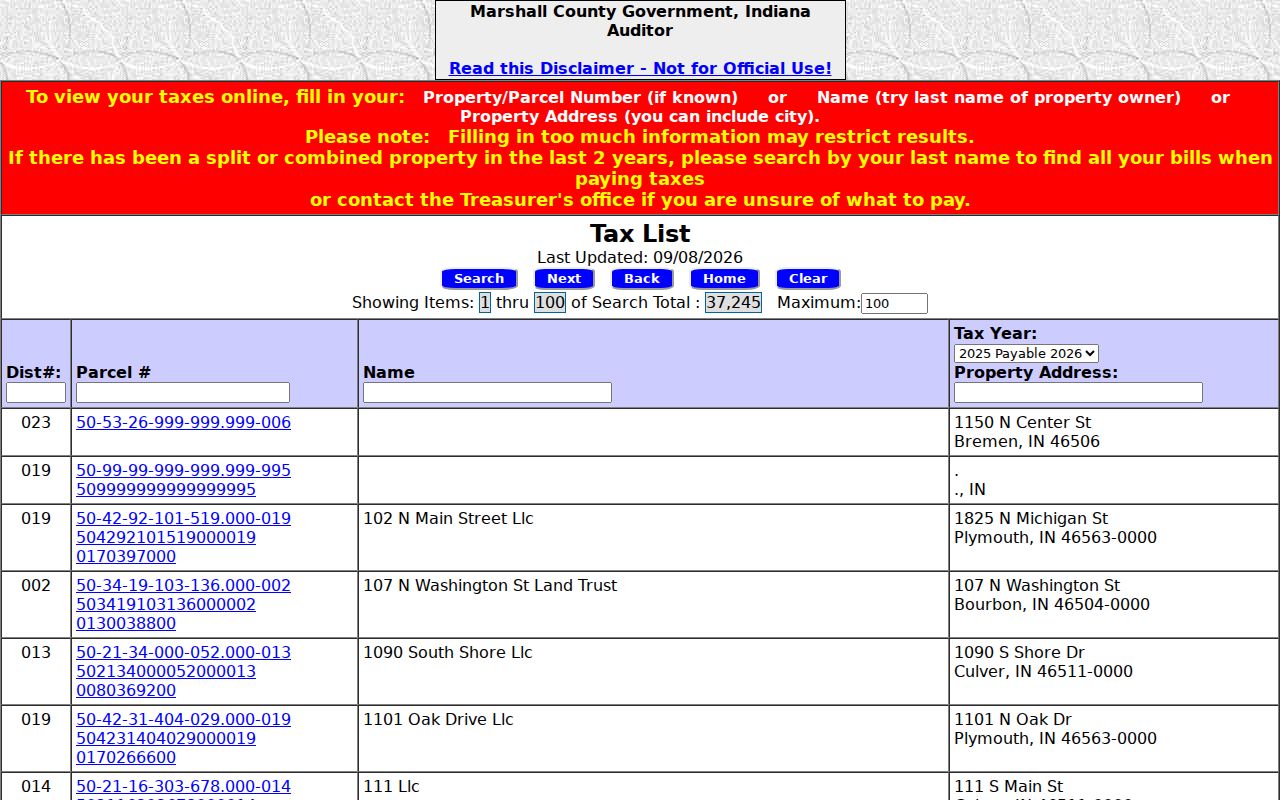
A common surname can return many pages of hits. Save the exact query so you can retrace it later. The observed parcel detail shows the fuller set of assessment and tax fields sitting behind a single result.
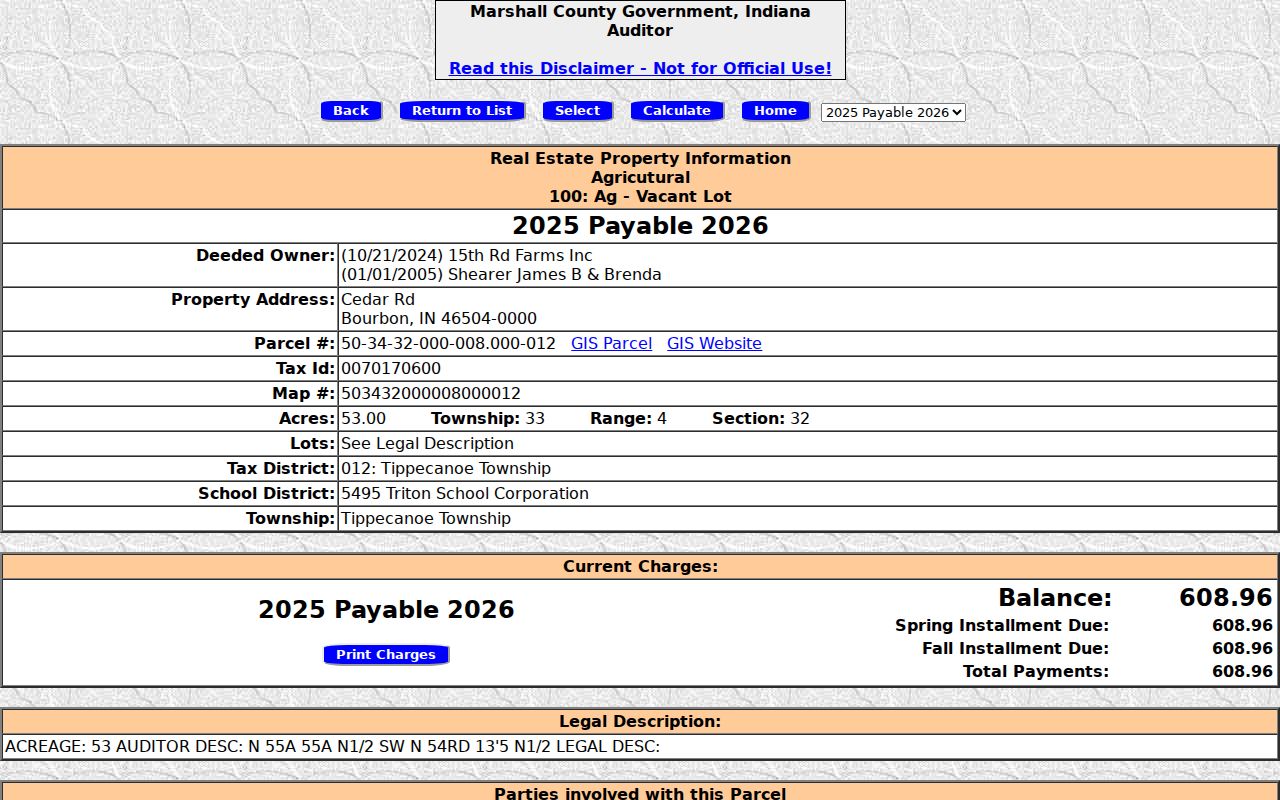
The parcel detail pulls together the owner of record line, parcel identifiers, legal description, classification, deductions, and the tax calculation. Keep them as one dated packet for your files. The Indiana Gateway tax lookup offers a second public way to cross-check a Marshall County tax bill.
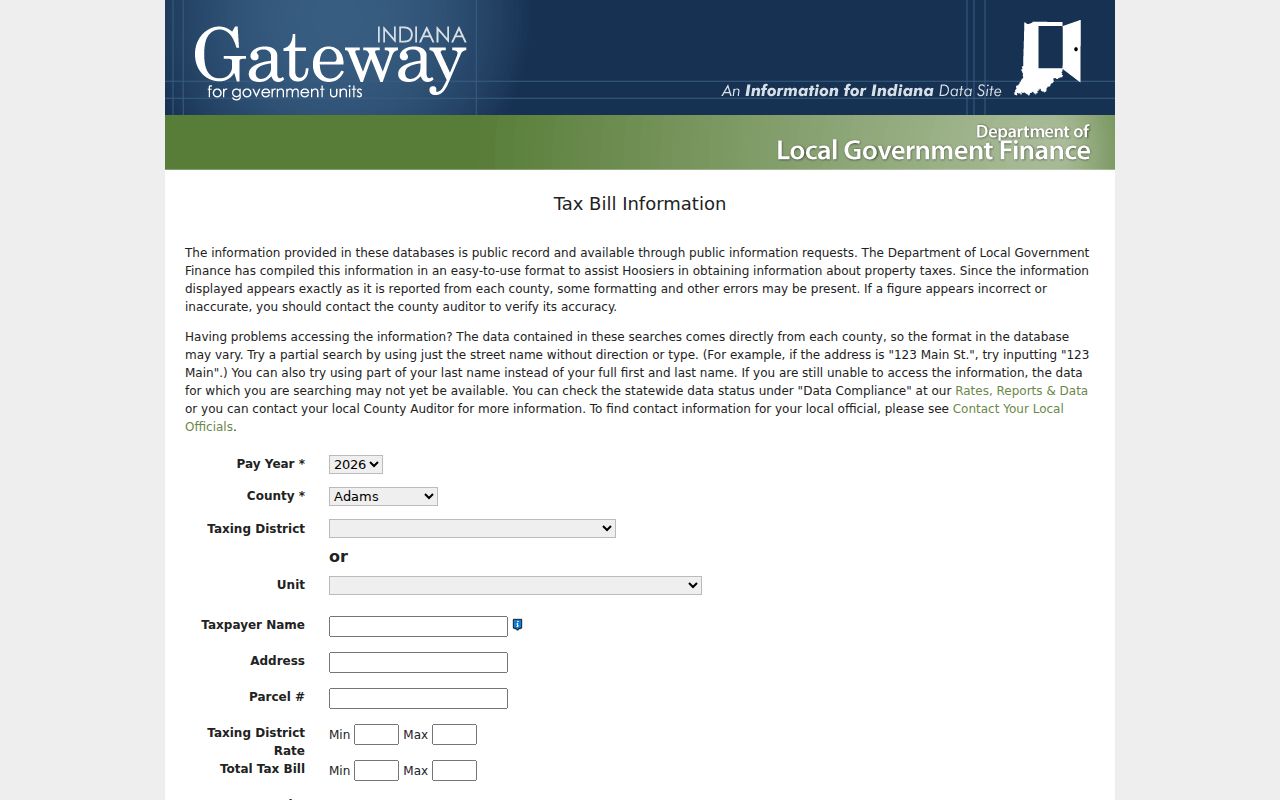
Gateway's county, district, taxpayer, address, parcel, and amount filters help you pin down the right bill. Its notice states the display is not the official record, though.
Look Up a Marshall County Bill
Start with the parcel, not the name. That is the rule for a clean Marshall County tax bill lookup. The Marshall County Treasurer page serves as the official hub, collecting payment, tax-list, Beacon, DLGF, and tax-sale links in one place. One caution belongs here: the taxpayer or Deeded Owner display never proves title, so do not read ownership out of a bill screen.
- Search DataPitstop or Gateway with the address or parcel number and select the intended payable year.
- Match the APN, legal description, tax district, and property address before reading the amount.
- Review assessment class, deductions, and the tax calculation shown for that year.
- Use the Treasurer's official payment route for current status, and inspect an official sale notice before drawing a delinquency conclusion.
- Assessed value
- The value placed on the parcel under Indiana's market-value-in-use framework.
- Tax rate or levy
- The public charges applied through the parcel's taxing district.
- Deduction
- An amount that reduces the value exposed to tax when statutory rules are met.
- Tax lien
- A claim arising from unpaid property tax, which requires record and status confirmation.
Note: A payment screen, a tax card, and a recorded deed serve different purposes and may carry different effective dates.
Marshall County Deductions and Credits
Deductions and credits are not interchangeable. The DLGF treats them as separate forms of relief. The parcel detail lists exactly what was applied for the year you select. For the paperwork behind those numbers, the Marshall County Assessor posts assessment definitions, forms, sales-disclosure material, PTABOA details, and appeal procedures.
When an online line is unclear, ask for the assessment file. A written request works best. It should include the full APN. It should also list the property address, the payable years, and the specific deduction or notice in question. Indiana's Access to Public Records Act, IC 5-14-3, guarantees inspection and copying of public records during business hours. That guarantee is subject to exceptions and lawful fees.
2026 Reassessment Changes the Clock
A new clock starts soon. The DLGF cyclical reassessment opens a four-year cycle on July 1, 2026, covering 2026 Pay 2027. That shift makes source dates matter more than ever. A 2025 parcel layer, a 2025 Pay 2026 tax card, and a fresh reassessment notice can all be accurate at once, each capturing a different stage of Marshall County's record cycle.
Annual adjustment adds another wrinkle. A value can move without any recent sale. Classification, deductions, trending, and reassessment all deserve a check before a difference gets blamed on the market. Keep the Form 11 notice, the parcel card, and any evidence backing the owner's view of the property.
Tax Sale Records Need Context
A delinquent balance is only a lead. It does not prove that a purchaser already owns the land. The 2025 Marshall County tax-sale notice described an online sale, registration steps, minimum-price terms, and a redemption framework built on 110 percent and 115 percent thresholds plus set interest. Those dates and terms apply to that notice alone. They should not be generalized to another sale.
Track each event on its own: the judgment or list date, the sale date, the certificate date, and the redemption deadline. Then check the Recorder for later instruments. Check the court file when litigation touches the parcel. A sale-list minimum bid is not the final acquisition cost, and a listing is never a deed.
Request Marshall County Tax Files
Online access is only one channel. The Assessor can provide a property card or a full assessment file. The Treasurer can confirm payment destination and bill status. Put any written request in focused form. State the complete APN, property address, payable years, the record wanted, the preferred format, and whether inspection or copies are needed. Ask for a fee estimate. Flag the online line that needs explanation.
Indiana's Access to Public Records Act permits any person to inspect and copy public records during regular business hours, subject to statutory exceptions. It does not open confidential material. An office need not answer broad research questions. Request the existing record itself: the parcel card, Form 11, deduction record, sales-disclosure reference, payment history, or tax-sale notice.
The Assessor is in Room 307 at 112 W Jefferson Street, Plymouth. Marshall County publishes no APRA fee schedule, electronic request address, or fixed production deadline, so confirm the method and cost with the custodian. Save both the request and the response whenever a needed year or field is not online.
Appeal a Marshall County Assessment
Indiana's general appeal route starts with the local assessor. DLGF allows an appeal after a Form 11 notice. The general deadline is June 15 of the notice year, or June 15 of the following year when no Form 11 arrives. The date on the actual notice controls. Confirm it with the Assessor and PTABOA first.
Strong evidence is parcel-specific: the notice, the current property card, corrected characteristics, dated photographs, comparable information, and documents explaining any damage or classification issue. The appeal contests the assessment. It does not contest the tax rate or a recorded deed. Ask which form and filing method apply to the particular notice.
Protect the deadline. Confirm the Form 11 date and current June 15 filing rule with the Marshall County Assessor before relying on a general calendar.
Online data does not answer everything. Contact Assessor Peter Paul in Room 307 at 112 W Jefferson Street, Plymouth, or call (574) 935-8525. A focused request can seek the property card, assessment record, deductions, sales-disclosure reference, and appeal notices. Name the payable years.